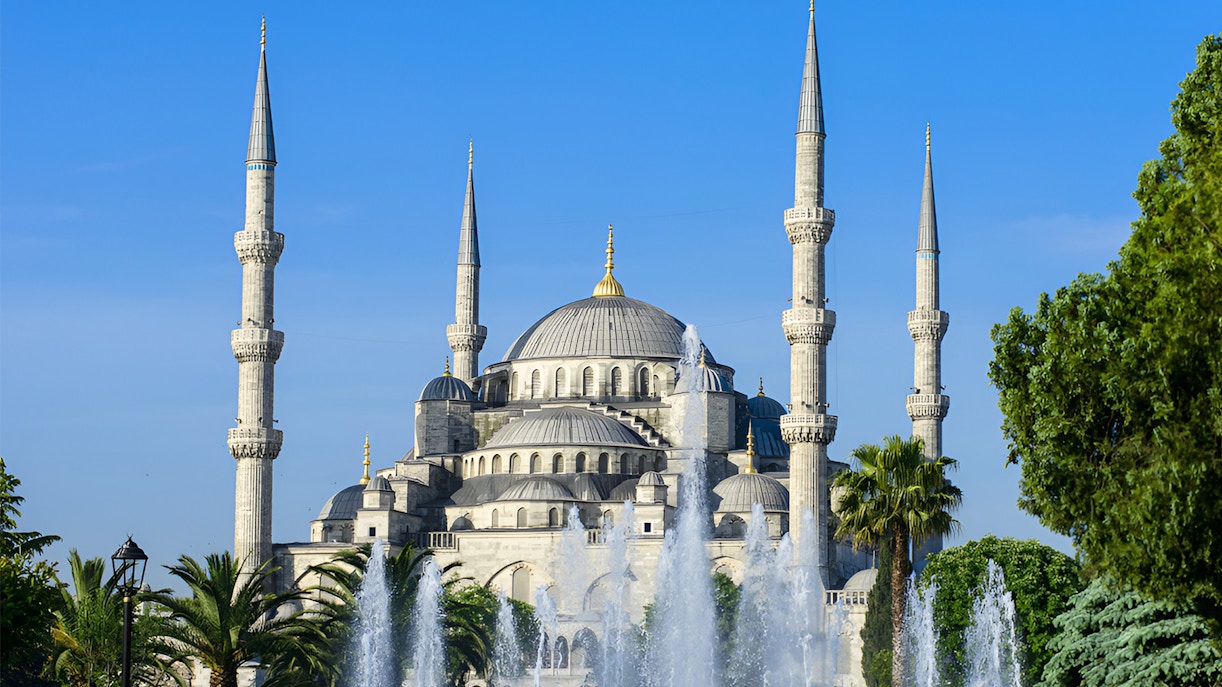
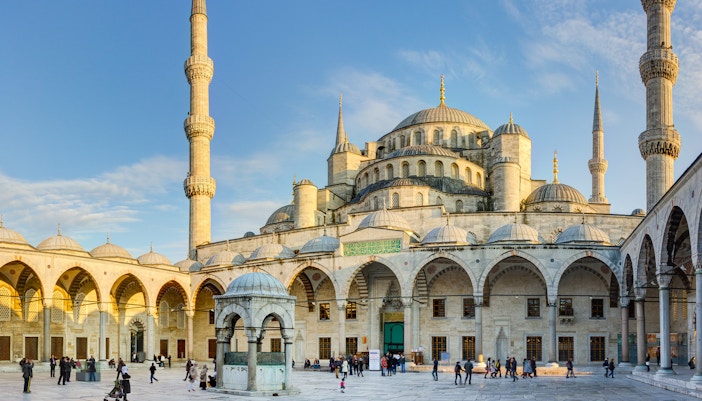
An interesting legend surrounds the unusual six minarets of the Mosque. Sultan Ahmed wanted them in gold, but the architect misheard it as six, given the words in Turkish for both sound similar. Since only the Prophet’s Mosque in Mecca had six minarets, it is believed that the Sultan avoided controversy by commissioning a 7th minaret in the Mecca Mosque, to maintain its supremacy.
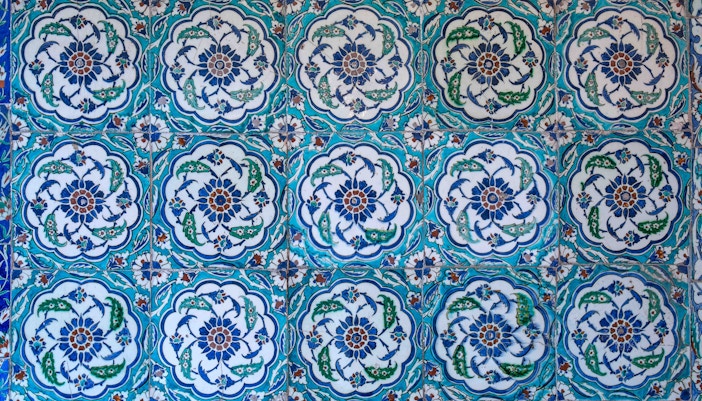
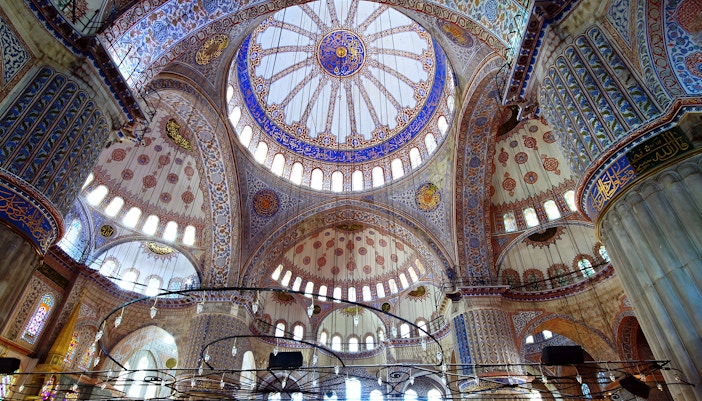
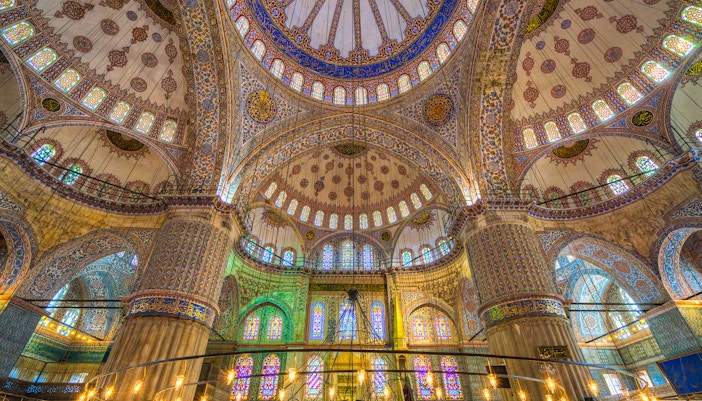
The Blue Mosque gets its popular name from the beautiful blue Iznik tiles that adorn its ceiling. The tiles come from Iznik in Turkey famous for its pottery. Handpainted with floral motifs and incredible calligraphy, these 20,000 blue tiles make the interiors an absolutely stunning sight.
A teenage sultan, Ahmed, wanted his legacy to shine in the Ottoman narrative; the chances of which were slim given his numerous military defeats. The Blue Mosque was his trump card and he was resolved to finish it despite a declining social situation and much opposition. He even took part in the construction of the Mosque on the first day.
Things to see at the Blue Mosque in Istanbul
Iznik tiles
The mosque is famous for its exquisite İznik tiles, featuring intricate floral patterns and calligraphy. Take the time and admire the stunning blue tiles that adorn the walls, pillars, and domes, taking visitors on a trip down the Ottoman reign in Turkey.
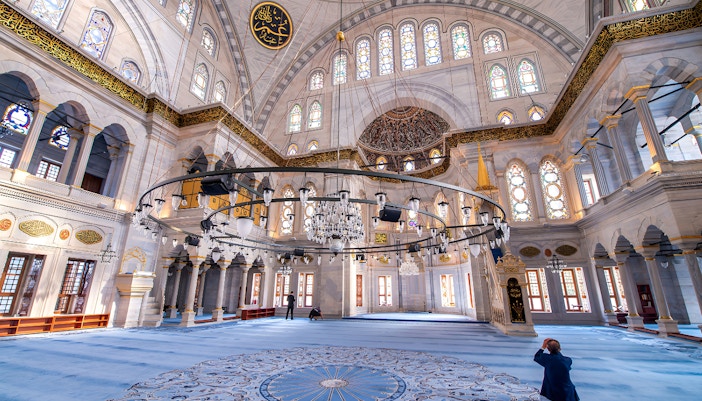
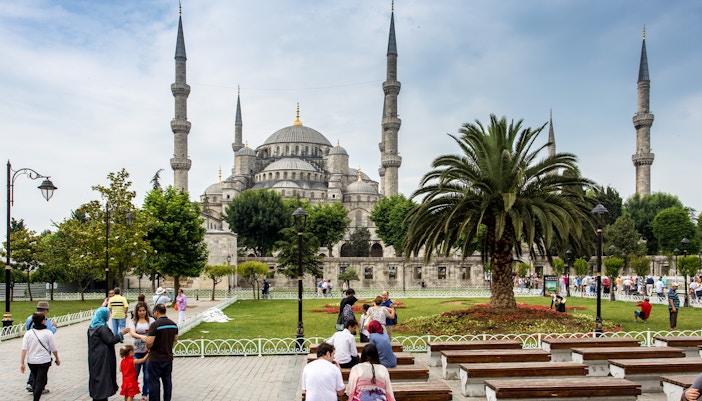
Upon entering the Blue Mosque, you will come across a spacious courtyard. The prayer hall is right after that, at the heart of the mosque, featuring high ceilings and impressive domes. The domes and semi-domes are signature elements of Ottoman architecture.
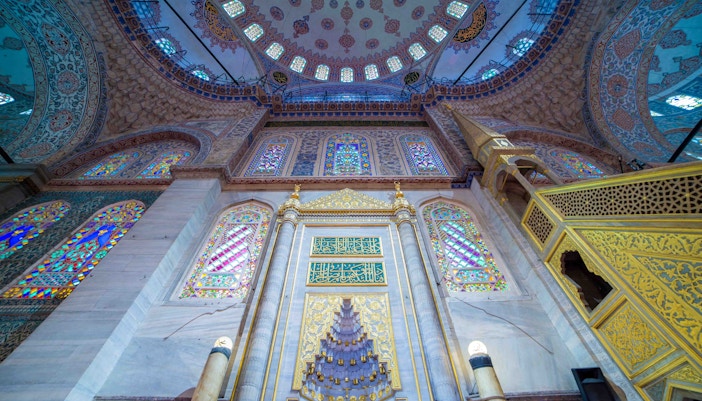
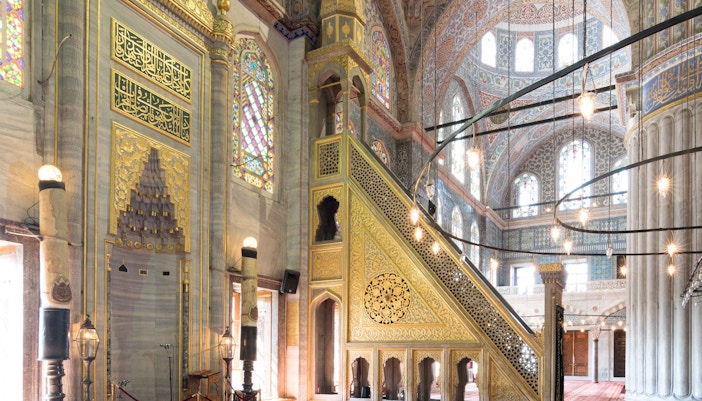
The mihrab is a beautifully decorated niche in the wall indicating the direction of Mecca (qibla). Adorned with intricate calligraphy and decorative elements, it is a significant focal point within the mosque. It was used by imams to lead a prayer.
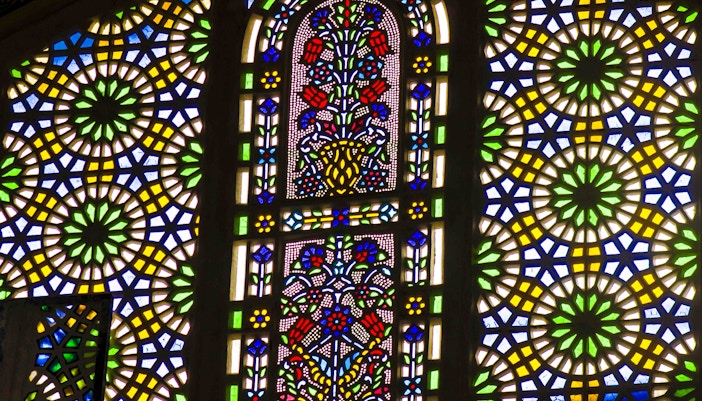
The Blue Mosque's interior is adorned with stained glass windows. During golden hours, it filters the sunlight in soft, colorful hues, illuminating the courtyard and interiors. These windows add to the ambiance and enhance its overall aesthetic appeal.
The minbar is a pulpit from where the khatib (preacher) delivered his sermons. This intricately carved piece showcases the craftsmanship of the Ottoman period and adds to the architectural splendor of the Blue Mosque.
Central dome
The central dome is a remarkable feature of the Blue Mosque, supported by four large columns, creating a sense of depth and grandeur within the mosque. As you explore it closely, you will see intricate floral designs and calligraphy on its surface.
History of the Sultanahmet Mosque in Istanbul
The Blue Mosque, also popularly known as the Sultanahmet Mosque, is a stunning reminder of the prosperous Ottoman era. It had been commissioned by Sultan Ahmed I, who reigned from 1603 to 1617 when the Ottoman reign was at its peak.
1609: Sultan Ahmed I sought to commission a mosque, whose architectural splendor would rival the nearby Hagia Sophia. The Blue Mosque was constructed on the site of the Byzantine Great Palace, which had been destroyed by fire.
1610 to 1612: Several skilled artisans and builders were employed to lay the foundation of Sultan Ahmed I's dream mosque. With the foundation secured, the workers began working on the walls and interior spaces.
1613 to 1616: The famed blue tiles, produced in the city of Iznik, were meticulously installed inside the Blue Mosque. As construction progressed, additional details like marble columns, calligraphy inscriptions, and stained glass windows were incorporated, further enriching the mosque's interior.
1616: The main structure of the Blue Mosque and some of its interiors were mapped out by this year. While the Blue Mosque is known for its 6 minarets, it is believed that it was built out of confusion. Such a display had only been reserved for the Prophet’s mosque in Mecca, hence Sultan Ahmed I received a lot of backlash for thinking too highly of himself. The Sultan had ultimately commissioned a 7th minaret for the Prophet’s Mosque to redeem his reputation.
1617: Around this time, workers added more tiles and architectural elements to the inside of the Blue Mosque. The mosque was opened to the public.
The Blue Mosque was commissioned by Emperor Sultan Ahmed I, who sought to rival the architectural grandeur of the nearby Hagia Sophia. The Sultanahmet Mosque was designed by the renowned architect Sedefkar Mehmed Agha, who studied under the famous architect Mimar Sinan.
Agha drew inspiration from Ottoman architectural traditions, particularly the works of his master. The mosque's grand scale, intricate details, and iconic blue tiles solidified its place as a landmark of Ottoman architectural prowess. Skilled artists adorned the mosque's interior with elegant inscriptions from the Quran and other religious texts. The construction of the mosque began in 1609 and was completed in 1616 during the reign of Sultan Ahmed I.
The Blue Mosque showcases a fusion of two architectural styles, blending traditional Ottoman architecture with elements borrowed from the Byzantine era. One of the mosque's distinctive features is its 6 minarets, which make it stand out from other mosques in Istanbul. These minarets serve the practical purpose of amplifying the call to prayer and contribute significantly to the mosque's imposing silhouette. The courtyard also has arching domes and semi-domes that enhance the splendor of the mosque.
The interior of the Blue Mosque is adorned with over 20,000 Iznik tiles, which give the mosque its popular name. These blue tiles, along with intricate calligraphy and geometric patterns, create a stunning visual display, adding to the mosque's grandeur and elegance. The mihrab (prayer niche) and minbar (pulpit) are crafted from exquisite marble, with elegant calligraphy inscriptions adorning its walls.
A spacious courtyard precedes the prayer hall, providing a serene space for ablutions and gatherings. Hundreds of windows are added to the domes and prayer halls, allowing for natural light to flood the interior, creating a beautiful interplay of light and shadow.
The Blue Mosque, with its 6 minarets and grand Central Dome, is one of the most famous architectural marvels in Istanbul. Its architecture is a fusion of Ottoman and Byzantine styles.
No, you do not need entry tickets to enter the Blue Mosque. If you want to book Blue Mosque guided tours, you have to purchase a ticket.
No, you do not need to purchase tickets to enter the Blue Mosque. However, if you want to delve deeper into the rich heritage of the mosque, you may opt for Blue Mosque guided tours. It is best to book guided tour tickets online in advance.
The Blue Mosque is located on Binbirdirek, At Meydani Cd No:10, 34122 in Istanbul, Turkey.
The Blue Mosque is open from 9 am to 6 pm every day throughout the year. It is closed only during prayer times and noon Friday prayers. Look out for Blue Mosque's prayer times when planning a visit.
We recommend you visit the Blue Mosque early in the morning, between 9 AM to 11:30 AM. The atmosphere is relatively calm and there are lesser crowds. You will be able to explore its interiors to the fullest.
Ottoman Emperor Sultan Ahmed I commissioned the construction of the Blue Mosque because he wanted to showcase the architectural splendor of the Ottomans and create a monument that would rival the nearby Hagia Sophia. The mosque’s grand design, intricate details, and unique fusion of Byzantine and Ottoman elements showcase the artistic splendor of the Ottoman Empire.
The Blue Mosque had been constructed between 1609 to 1616. It has been standing as a stunning remnant of the Ottoman Empire’s glory for the last 414 years.
The blue Iznik tiles adorning the Blue Mosque's interiors have given the mosque its name. The mosque’s 6 minarets also make it stand out from the other monuments in Istanbul. It is said that the minarets were constructed due to a misunderstanding and to curb the backlash he received from the public, the Sultan had to construct another minaret at the Prophet’s mosque.
When visiting the Blue Mosque, look out for its blue Iznik tiles, grand Central Dome, and 6 minarets. These architectural details are a fusion of Byzantine and Ottoman styles. Make sure to also look at its Mihrab, Minrab, and walk through its spacious courtyard to get a feel of the opulence of the Ottoman era.
The main Blue Mosque entrance is located on the northern side of the structure, facing the Hippodrome. The western entrance is situated opposite the Hagia Sophia. This entrance is the most recognizable gate, offering access to wheelchair visitors and a shorter walk to the inner courtyard. The Sultanahmet Mosque also has a gate towards the southern side. You can access it by following signs from the main entrance and taking a right turn to reach the south door.
No, the Blue Mosque is not typically open at night. The mosque is open from 9 am to 6 pm throughout the year. It is only closed during prayer hours.